
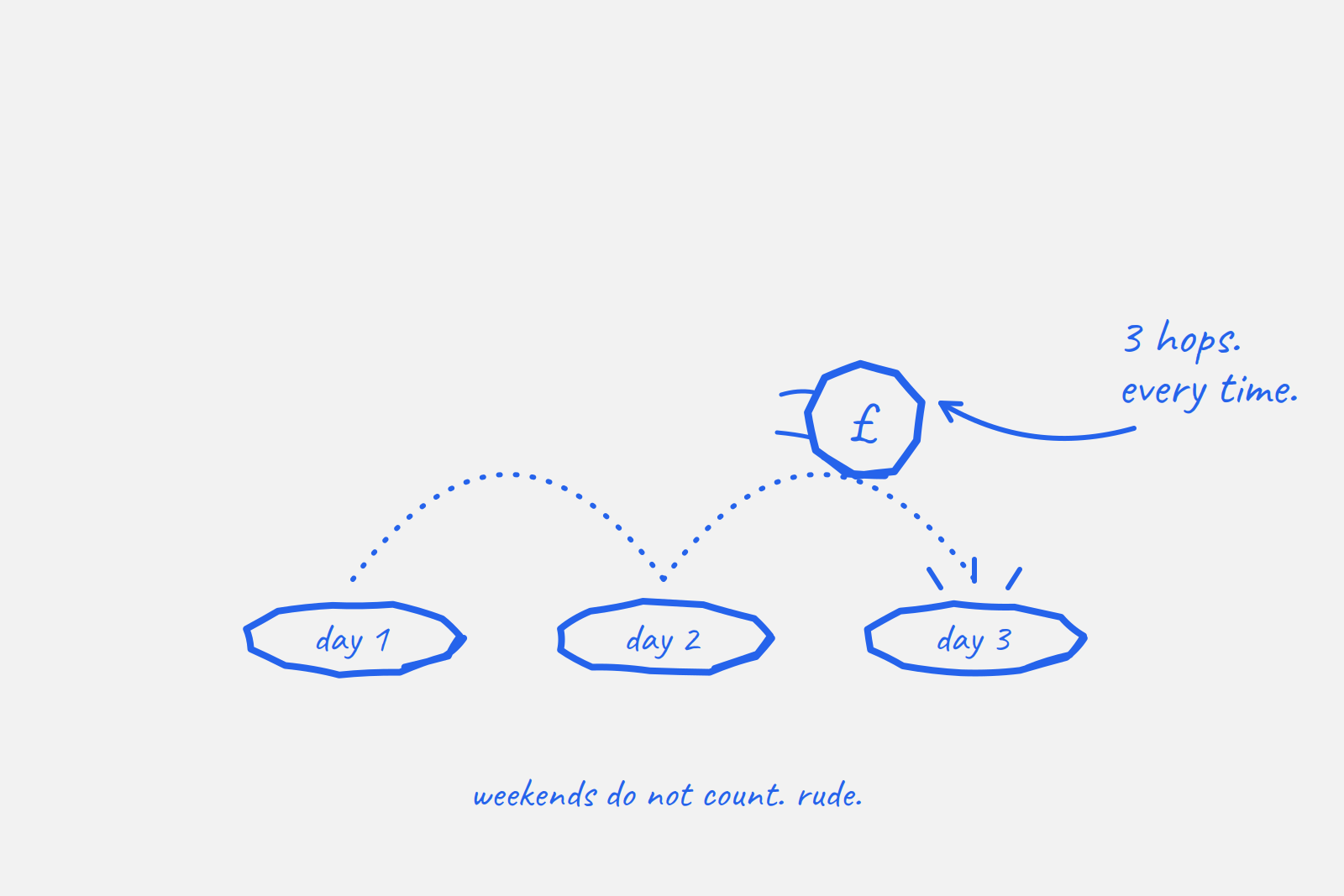
In brief: The core Bacs processing cycle for a UK Direct Debit runs across three bank working days: the payment file is submitted on day one, processed on day two, and the customer is debited and the collecting account credited on day three.
A first payment normally takes longer because the mandate must be set up and the customer must receive the required advance notice. Your provider’s payout arrangements can add another step, so “three days” is the rails, not always the entire journey.
What is the three-day Bacs cycle?
Bacs describes the collection cycle in three stages:
- Input day — day one. The business, provider or bureau submits the payment instruction to Bacs within the relevant cutoff window.
- Processing day — day two. Bacs sorts and delivers the payment information to the payer’s bank or building society.
- Entry day — day three. The customer’s account is debited and the collecting account is credited.
These are bank working days in England. Weekends and English bank holidays do not count.
What does that look like in practice?
A file submitted on Monday for the normal cycle reaches entry day on Wednesday. A file submitted on Thursday reaches entry day on Monday, provided Monday is not a bank holiday and the submission met the cutoff.
Cutoff times matter. A payment instruction sent after a provider’s daily deadline may enter the next available cycle. Providers often set their own earlier operational cutoffs before the Bacs window closes.
Why can the first Direct Debit take longer?
The first collection includes work that later collections do not:
- the customer approves a Direct Debit mandate;
- the instruction is lodged with the customer’s bank or building society;
- the customer receives confirmation and advance notice; and
- the payment is then submitted into the three-day cycle.
The official Guarantee wording says changes to the amount, date or frequency are normally notified ten working days before the account is debited, unless another notice period has been agreed. The same practical notice arrangements matter when a new collection is established.
That means “mandate approved today, money tomorrow” is usually not the right expectation. Plan the first collection with enough room for setup, notice and processing.
Does the business receive the money on day three?
In the underlying Bacs cycle, debit and credit occur on entry day. A payment provider may collect into an account it operates and then pay the business according to its own settlement schedule. Some providers also hold funds for risk checks or apply different timings to first collections.
Ask a provider two separate questions:
- On what date is the customer debited?
- On what date are cleared funds available to the business?
They sound like the same question until they produce two different answers.
Can Direct Debit be scheduled in advance?
Yes. Bacs says payment instructions can be submitted up to 30 days before the payment date. In an invoice workflow, the useful approach is to read the due date in advance and submit at the correct time so entry day falls on, or is aligned with, that date.
This is why raw speed matters less for scheduled invoices than predictability. If the due date is known, the work can happen before the customer is due to pay.
What happens if a Direct Debit fails?
A collection can fail for reasons such as insufficient funds, a cancelled instruction, an invalid account or a closed account. Failure reporting does not always arrive at the same moment as the attempted debit, so businesses should watch provider reports and avoid marking an invoice definitively paid before the payment is confirmed.
A failed collection may be retried where appropriate, but the customer should be told what will happen and any retry must follow the agreed notice and provider rules.
Do bank holidays change Direct Debit dates?
Yes. Because the cycle uses working days, a bank holiday pushes the relevant stages forward. Around Christmas, Easter and other holiday periods, businesses should consult the Bacs processing calendar and schedule earlier.
Calendar awareness is not glamorous. Neither is explaining to payroll why Thursday apparently disappeared.
How NRTH handles invoice timings
NRTH is designed to use the invoice due date from connected accounting software and schedule the Direct Debit workflow around it. The aim is that the business does not have to calculate input day for every invoice manually.
Businesses should still understand their agreed notice period, the provider settlement schedule and how failures are reported. Automation should hide the repetitive work, not the important facts.
Frequently asked questions
Is Direct Debit always exactly three days?
The core Bacs processing cycle spans three working days. The full journey can be longer because of mandate setup, advance notice, provider cutoffs, bank holidays and provider payout timing.
How long should I allow for a first collection?
Allow enough time for the customer to approve the mandate, for the instruction and confirmation process, for the agreed advance-notice period, and for the three-day collection cycle. The precise total depends on the provider and the arrangement with the customer.
Can a Direct Debit arrive on a weekend?
The Bacs cycle operates on bank working days, so entry day does not fall on a weekend or English bank holiday.
Raise the invoice. Let the calendar do its job.
NRTH connects invoice due dates with Direct Debit collection so timing does not live in somebody’s spreadsheet. See how the workflow works.
Sources and further reading
- Bacs: the Direct Debit processing cycle
- Bacs processing calendar
- The official Direct Debit Guarantee and notice wording
Last reviewed: 21 July 2026. Provider cutoffs and settlement schedules vary; confirm the timings that apply to your service.