
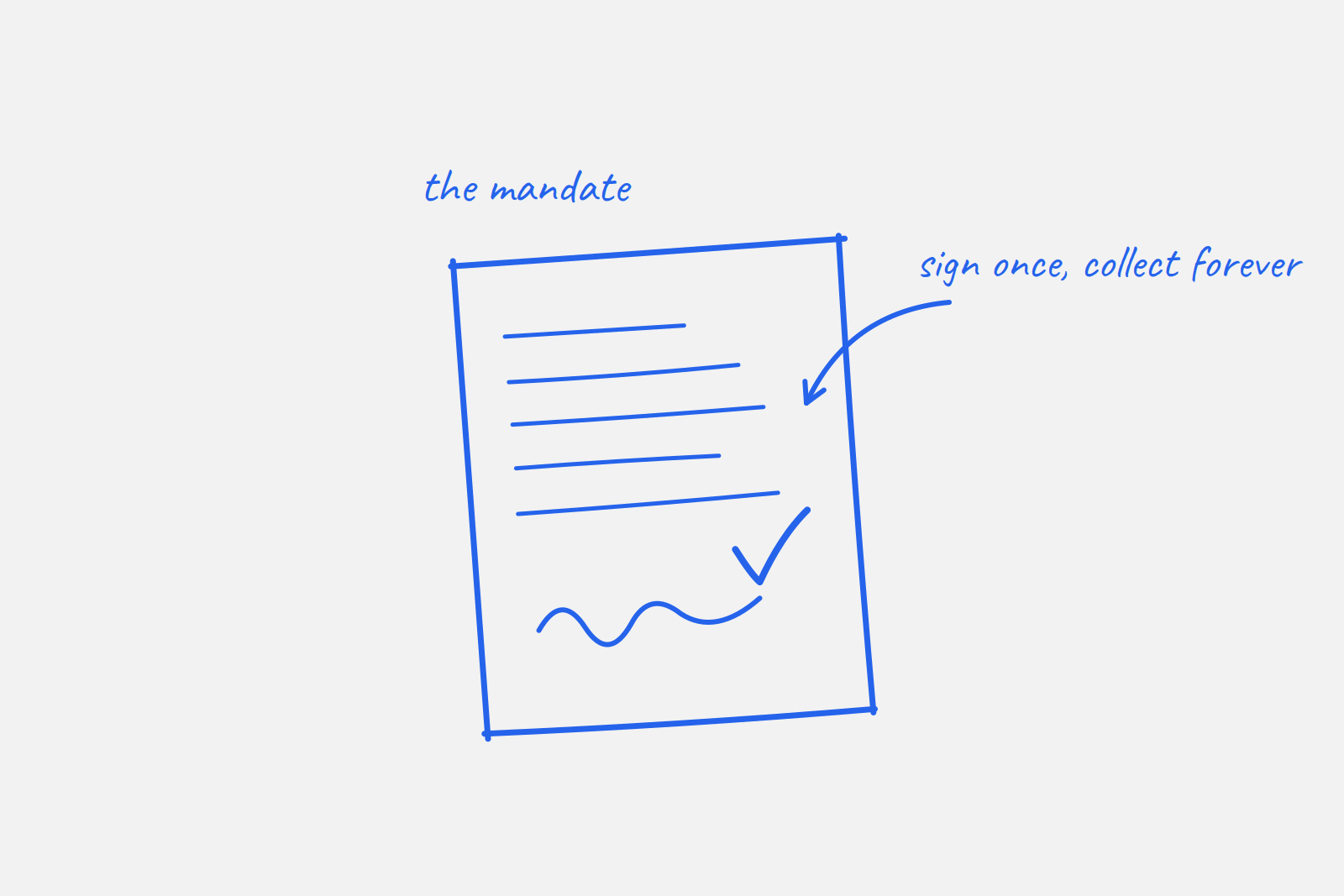
In brief: A Direct Debit mandate is the customer’s instruction to their bank or building society authorising a named organisation to collect payments from their account. It is usually approved once and can support multiple future collections.
The formal Bacs term is a Direct Debit Instruction, often shortened to DDI. “Mandate” is the everyday name. Same job, fewer capital letters marching around.
What does a Direct Debit mandate authorise?
The mandate authorises the payment method. It tells the payer’s payment service provider that the collecting organisation may request Direct Debit payments from the account.
It does not, by itself, prove that every amount is contractually due. The invoice, subscription agreement or service contract explains the underlying obligation. The Direct Debit Instruction provides the route through which an agreed payment can be collected.
What information is normally required?
A paperless mandate commonly asks for:
- the account holder’s name;
- the bank or building society account number;
- the sort code;
- confirmation that the person has authority to authorise Direct Debits from the account; and
- the identity of the organisation that will collect the payments.
Business accounts sometimes require more than one authorised person, and not every account accepts Direct Debits. A good signup flow checks eligibility and makes the authorisation wording clear before submission.
How can a customer approve a mandate?
Direct Debit Instructions can be taken on paper or through approved paperless channels, including online and telephone journeys. For an internet mandate, the customer enters their details into the approved signup screen and confirms the instruction.
Under the Paperless Direct Debit process, the collecting organisation is responsible for validating the details and lodging the instruction through AUDDIS. The customer must receive confirmation of the instruction within the required timeframe. Bacs states that confirmation is normally sent within three working days, or it may be combined with the advance notice for the first collection where the timing rules are met.
Does one mandate cover more than one invoice?
Yes. One active mandate can support multiple collections from the same organisation. That is the practical reason Direct Debit works well for repeat invoicing.
Imagine a customer owes £600 in July and £840 in August. A standing order would normally need the customer to change the fixed amount. With Direct Debit, the collecting organisation can request each invoice value under the existing mandate, provided the customer receives the agreed advance notice.
Can the date and amount vary?
Yes. A Direct Debit may be fixed or variable. The collecting organisation must tell the payer about the amount, date or frequency in advance. The standard notice period is normally ten working days unless another period has been agreed.
This notice is not administrative fluff. It is one of the core protections that allows a payer to see what is due before the account is debited.
How long does a mandate take to become active?
The exact customer journey depends on the provider, the type of instruction, submission cut-offs and the notice arrangement. Lodging the instruction and collecting the first payment are separate steps.
Once a collection enters Bacs, the core payment cycle spans three English bank working days. The first payment usually needs more planning because the mandate and advance-notice requirements come first. Read the full Direct Debit timing guide before promising a collection date.
Can the customer cancel the mandate?
Yes. The payer can cancel a Direct Debit through their bank or building society and should also inform the collecting organisation.
Cancellation stops future collections under that instruction. It does not necessarily cancel a contract, settle an unpaid invoice or remove another legal obligation to pay. The business and customer may need to agree a different payment method for anything still owed.
What happens if the details are wrong?
An instruction may be rejected if the account details are invalid, the account cannot accept Direct Debits or the authorising person does not have the required authority. Clear validation at signup reduces avoidable failures.
If an error is made in setting up or collecting the Direct Debit, the payer has protection under the Direct Debit Guarantee.
Does a mandate expire?
Instructions that have not been used for an extended period may become dormant under scheme arrangements. The relevant timeframe and reactivation process should be confirmed with the sponsoring payment service provider or Direct Debit provider before attempting an old collection.
That is especially important for businesses with seasonal customers: “They approved it ages ago” is not a robust payment process.
What should a good mandate journey look like?
- Recognisable: the customer can clearly see which organisation is asking for permission.
- Plain English: the purpose of the instruction is explained without hiding behind payment jargon.
- Secure: bank details are captured through a properly protected form with appropriate access controls.
- Confirmed: the customer receives confirmation and the Direct Debit Guarantee wording.
- Trackable: the business can see whether the mandate is pending, active, rejected or cancelled.
How NRTH handles mandates
NRTH provides the customer onboarding journey, tracks mandate status and connects an active instruction with the invoices raised in Xero, QuickBooks or Sage. Once the mandate is active, future eligible invoices can move into the collection workflow without rebuilding payment details each time.
For the wider process, start with how Direct Debit works.
Frequently asked questions
Is a mandate the same as a contract?
No. The mandate authorises the bank-account collection method. The contract or invoice sets out the goods, services, amount and payment obligation.
Does the customer need to sign paper?
Not necessarily. Approved paperless Direct Debit journeys can take instructions online or by telephone, subject to the relevant scheme and sponsor requirements.
Can a mandate collect different invoice values?
Yes. It can support variable collections as long as the payer receives the required advance notice of the amount and date.
Can a business reactivate a cancelled mandate?
A cancelled instruction should not simply be reused. The customer will normally need to authorise a new instruction before further Direct Debit collections are requested.
Sources and further reading
- Bacs: what a Direct Debit Instruction does
- Bacs: Paperless Direct Debit
- Bacs: Direct Debit and AUDDIS FAQs
Last reviewed 21 July 2026. Published by the NRTH team.
One mandate should remove work, not create another spreadsheet.
NRTH tracks customer approval and connects it to invoice collection. Talk to the team about the workflow.