
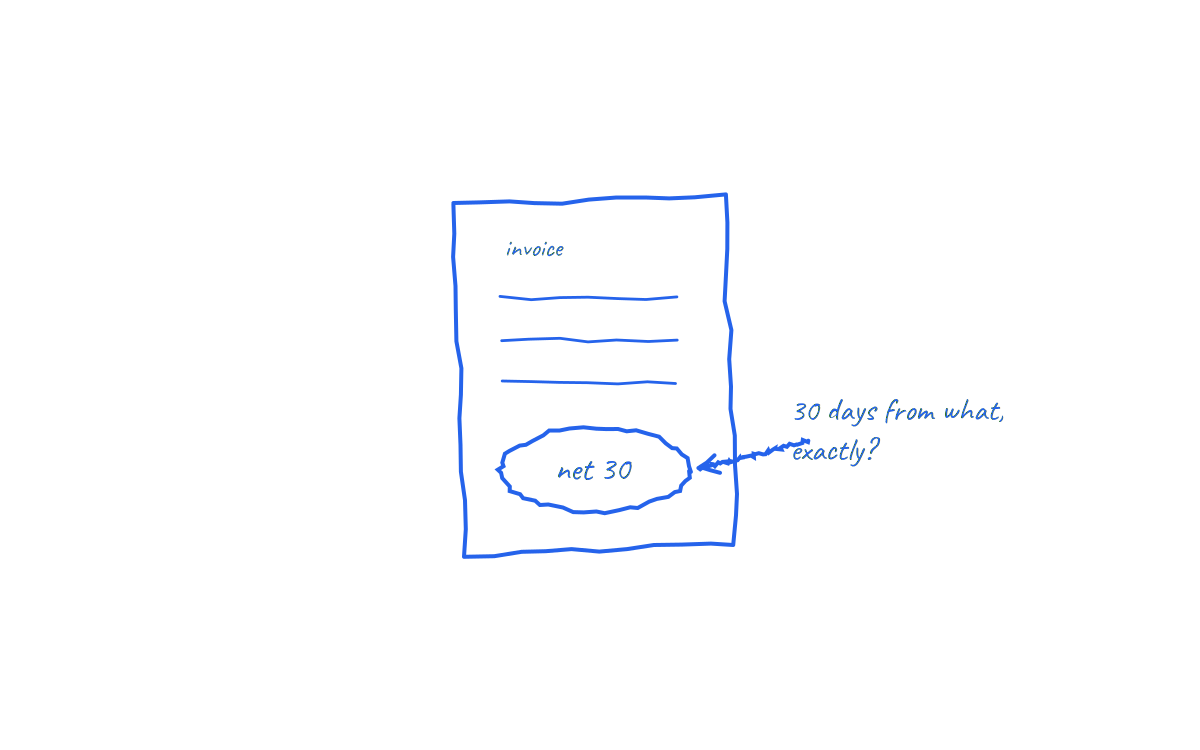
In brief: Payment terms are the agreed rules for when an invoice must be paid. Net 30 means 30 days from the invoice date. EOM means end of month. The best term is the one agreed clearly before work starts, written on the invoice as a specific calendar date, and backed by a payment method that actually delivers on that date.
Vague terms are one of the quietest causes of late payment. This guide covers what each term means, how to choose, and how the 2026 UK reforms change the landscape.
The common payment terms decoded
- Due on receipt: payment expected immediately. Realistic for small amounts and card or instant transfer; optimistic for anything needing approval.
- Net 7, 14, 30, 60, 90: full payment due that many days after the invoice date. Net 30 is the most common UK default.
- EOM: end of month. Net 30 EOM means 30 days after the end of the invoice month, which can quietly add up to four weeks versus plain net 30.
- CIA or CBS: cash in advance or cash before shipment. Payment before delivery, used for new or high risk customers.
- Stage or milestone terms: percentages due at defined project points, such as 40% on signing, 40% at delivery, 20% on completion.
- 2/10 net 30: a 2% discount for payment within 10 days, otherwise full amount in 30. Early settlement discounts trade margin for speed; price that trade deliberately.
- Retention terms: a percentage held back for a defined period, common in construction. Track retentions separately or they become permanent gifts.
What do UK businesses actually use?
Net 30 remains the working default for B2B services, with larger customers often pushing for 45, 60 or 90 days. The direction of policy is against long terms: the reform package confirmed in March 2026 moves towards capping payment terms at 60 days where large firms pay smaller suppliers, with statutory interest becoming mandatory on late commercial payments.
Where no term is agreed at all, the law implies a 30 day default for commercial debts, and public sector bodies are held to 30 days. Silence does not mean the customer chooses; it means the statute does.
How to choose your terms
- Match the term to your cost cycle. If you pay staff monthly and suppliers on 30 days, offering customers 60 days means financing a month of gap yourself. The cost of that gap is quantified in the true cost of late payments.
- Segment by risk. New customers earn shorter terms or deposits. Proven payers can earn longer terms as a commercial concession, not a default.
- Decide your negotiation floor. Know in advance the longest term you will accept and what you require in exchange, such as automatic collection or a deposit.
- Keep it boring. One or two standard terms across the customer base are enforceable. Fifteen bespoke arrangements are a spreadsheet nobody maintains.
Writing terms that hold up
- Agree before work starts. Terms in the proposal and contract, restated at onboarding. A term first mentioned on the invoice is an opening offer, not an agreement.
- State a calendar date. "Due 14 August 2026" removes every interpretation argument that "net 30" invites. It also starts a precise clock for statutory interest.
- Define the trigger. Thirty days from what: invoice date, delivery, acceptance? Say so.
- Name the payment method. A due date without an agreed collection route is a hope with a deadline.
- State the consequences. Reference statutory interest and compensation on late payment. Deterrence printed in advance beats penalties argued afterwards.
Terms are a promise. Collection is the delivery.
Here is the uncomfortable truth: official statistics still show a meaningful share of invoices paid late regardless of the term on the paper. A term defines when payment should happen. It does nothing to make payment happen.
That is why the strongest setups pair clear terms with automatic collection. With a Direct Debit mandate in place, the invoice amount is collected on the agreed due date, and the term stops being a request. The comparison of collection methods is in Direct Debit versus card versus bank transfer, and the full prevention system in how to stop chasing unpaid invoices.
Renegotiating terms with existing customers
Change terms at natural moments: renewal, a price review, a new project. Frame the move around certainty for both sides, offer automatic collection as the mechanism, and give notice in writing. A customer who resists any defined term, on any method, is answering a question you should be glad you asked early.
How NRTH makes terms real
NRTH reads the due date on each invoice in Xero, QuickBooks or Sage and schedules the Direct Debit collection to match it. The term you agreed becomes the date the money arrives, without a reminder sequence carrying the load. Net 30 finally means 30.
Frequently asked questions
What does net 30 mean on an invoice?
Full payment is due 30 days after the invoice date, unless the contract defines a different trigger. Stating the resulting calendar date on the invoice avoids disputes.
What are the standard payment terms in the UK?
Net 30 is the common default for B2B invoices. Where nothing is agreed, a 30 day statutory default applies to commercial debts, and the 2026 reforms move towards a 60 day cap on large firms paying smaller suppliers.
Can I charge for late payment beyond my terms?
Qualifying B2B debts can attract statutory interest at 8% above base rate plus fixed compensation, subject to your contract. The rules and the maths are covered in our late payment interest guide.
Should I offer early payment discounts?
Only with the cost priced. A 2% discount for paying 20 days early is an expensive way to buy speed; automatic collection on the due date usually achieves certainty without giving up margin.
A payment term is a promise about a date. Collection is what keeps it.
See how NRTH collects invoices on the due date you agreed, or talk to the team.
Sources and further reading
- GOV.UK: invoicing and payment obligations
- Small Business Commissioner: getting invoices right
- The 2026 late payment reforms explained
Last reviewed: 21 July 2026. This is general information, not legal advice. Check current statutory rules before relying on defaults.