
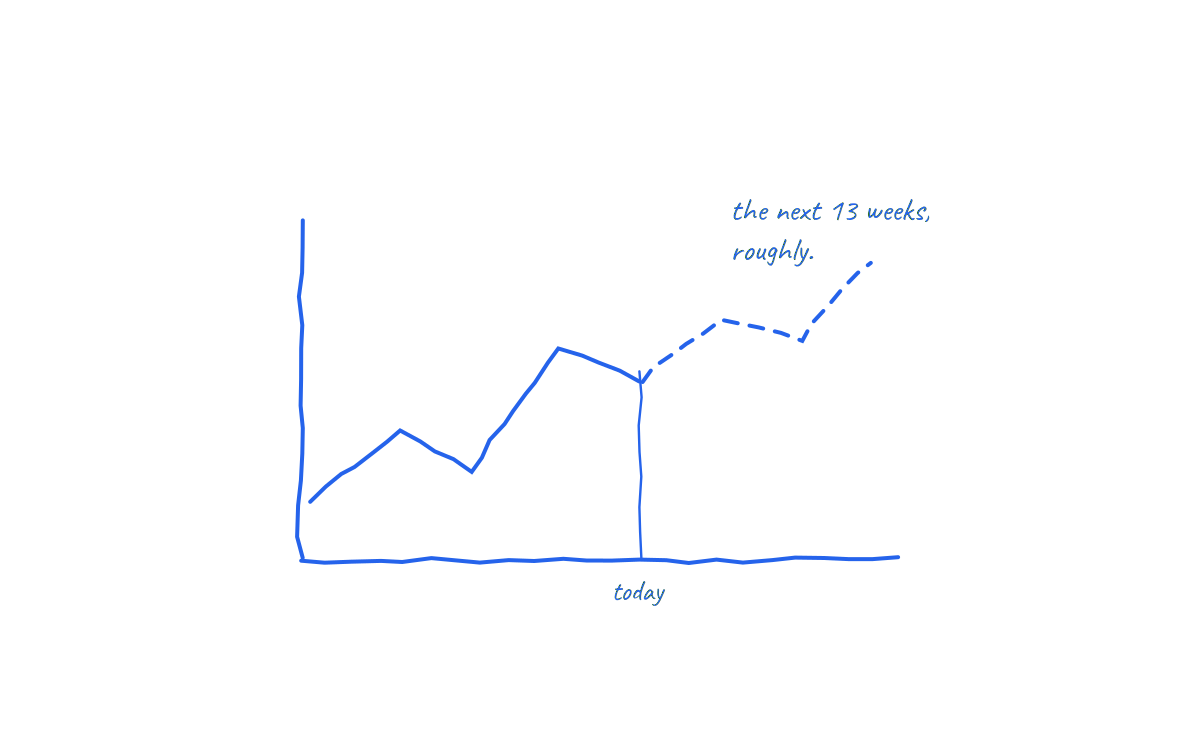
In brief: A cash flow forecast is a simple weekly or monthly projection of money in, money out and the resulting bank balance. For a small business the practical tool is a 13 week rolling forecast, updated weekly, built on when cash actually clears rather than when invoices are raised.
The forecast will not make customers pay on time. But it tells you weeks in advance where a gap is coming, which converts a crisis into a decision.
Why forecast at all?
Profitable businesses run out of cash. It is one of the oldest failure modes in business, and late payment is a leading cause: UK research estimates around 14,000 businesses close each year because of late payments, roughly 38 a day, with about £26 billion owed at any time. A forecast is the early warning system that turns "we might be short in March" into a plan made in January.
It also changes behaviour upstream. Once you see each customer's real payment pattern in the forecast, terms, credit limits and collection methods stop being abstract policies and become levers with visible cash consequences.
The 13 week rolling forecast
Thirteen weeks, one quarter, is the sweet spot: long enough to see problems coming, short enough to stay accurate. The structure:
- Opening balance: the actual bank position at the start of each week.
- Cash in: customer receipts in the week the money is expected to clear, plus any other income such as VAT refunds or funding.
- Cash out: payroll, rent, suppliers, VAT, PAYE, corporation tax, loan repayments, subscriptions, owner drawings.
- Closing balance: opening plus in minus out. This becomes next week's opening.
Update it every week: replace forecast with actuals, roll a new week 13 onto the end, and note why any week missed. The misses are the education.
The rule that makes or breaks it
Enter income when the cash clears, not when the invoice goes out. If a customer typically pays 45 days after invoicing, the receipt belongs in week 6 or 7, not week 0. Base each customer's timing on their actual behaviour, which your aged debtors report already knows, rather than the terms on paper.
This single habit is where most first forecasts fail. A forecast built on due dates describes the business you wish you had. A forecast built on clearing dates describes the one you run. Our guide to why clients pay invoices late explains the gap.
Forecasting the hard lines
- Payroll: fixed date, no flexibility. It anchors everything else.
- VAT and PAYE: quarterly and monthly cliffs that sink businesses which treated collected tax as spendable cash. Ring fence it in the forecast the week it is collected.
- Annual costs: insurance, subscriptions and renewals arrive as lumps. List them by month so no January surprises you.
- Seasonality: use last year's pattern as the baseline, then adjust for what you know is different.
Reading the forecast
Three things to look at each week:
- The minimum balance: the lowest point in the 13 weeks. That number, not the current balance, is your real headroom.
- The trend: is the closing balance rising or falling across the quarter once one off items are stripped out?
- Concentration: how much of the incoming cash depends on one or two customers paying on time? That is your fragility measure, and the full cost of it is set out in the true cost of late payments.
Closing a forecast gap
When the forecast shows a dip below comfort, you have weeks to act, and the options rank roughly like this:
- Accelerate receipts: chase committed dates on overdue invoices, invoice faster, and move repeat customers to automatic collection so receipts land on due dates.
- Reschedule payments: agree revised supplier dates early, when you are asking from strength rather than apologising from weakness.
- Trim discretionary spend: pause what can wait until after the dip.
- Arrange finance before you need it: overdrafts and invoice finance are cheapest and easiest to obtain when the forecast shows a plan, not a panic.
The forecasting shortcut: predictable receipts
The volatile line in every small business forecast is customer receipts. Everything else is largely known. So the highest leverage improvement to forecast accuracy is making receipts predictable, and that is a collections decision, not a spreadsheet decision.
Invoices collected by Direct Debit land on scheduled dates. The receipt line stops being a probability cloud and becomes a calendar. With NRTH, invoices raised in Xero, QuickBooks or Sage are collected on their due dates under an approved mandate, and the forecast inherits that certainty. The wider system is in how to automate invoice collection.
Tools: spreadsheet or software?
Start with a spreadsheet; the discipline matters more than the tool. Graduate to forecasting software when the customer count makes manual receipt timing tedious, and prefer tools that read live data from your accounting platform so actuals update themselves. Whatever the tool, the weekly review is the product. A forecast nobody reads is decoration.
Frequently asked questions
How far ahead should a small business forecast cash flow?
Thirteen weeks rolling for operational decisions, with a lighter 12 month view for planning items like tax, hiring and investment.
How often should the forecast be updated?
Weekly. Replace forecasts with actuals, roll the window forward and investigate the misses. A monthly update is a report; a weekly update is a control.
What is the most common forecasting mistake?
Entering income on the invoice or due date instead of the realistic clearing date. The second most common is forgetting VAT and other tax cliffs.
Can forecasting fix late payment?
No, it exposes it. Fixing it means clearer terms, tighter credit decisions and automatic collection, which then feed a calmer forecast.
A forecast shows you the gap. Predictable collection is what closes it.
See how NRTH puts customer receipts on the calendar, or talk to the team.
Sources and further reading
Last reviewed: 21 July 2026. This is general operational information, not financial advice.